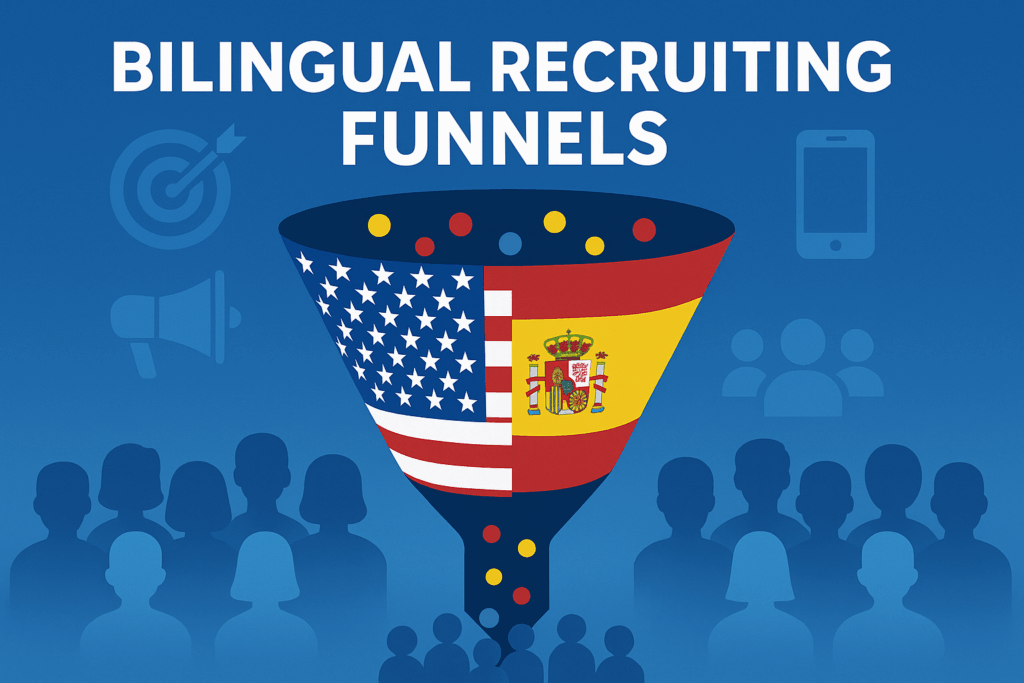
In the face of overwhelming competition in today’s digital world, marketers are in a constant race for new ways to expand their reach, devoid of the data quality compromise. A really good option that always hits the mark is the implementation of bilingual recruiting funnels that deploy Spanish English lead forms to involve both language communities seamlessly. By providing a smooth experience—mainly through in-app solutions, for example, LinkedIn Lead Gen Forms—businesses can make use of the twofold impact, cater to the underrepresented markets, and augment diverse driver sourcing efforts. This article informs the readers about how the bilingual funnels function, why they perform better than the monolingual ways and the practical steps to create forms that get the conversions on a larger scale.
The Case for Bilingual Funnels
A bilingual funnel is a marketing channel that aims to assist customers with information and lead-capture mechanisms in two languages—usually, Spanish and English. Bilingual funnels can create a unified experience instead of the need to choose between separate landing pages for the languages and thus let users manually select their language or automatically detect the setting based on browser settings or profile data. The encapsulation of this method:
- Boosts Engagement: Audiences feel more at home when they are spoken to in their native language.
- Enhances Inclusivity: It epitomizes the brand as culturally sensitive that is a must in industries that need to have diverse sourcing strategies.
- Improves Data Quality: Knowledgeable users are more likely to yield precise information when the forms are in their preferred language.
By overcoming the distance between the marketer’s wishes and the user’s convenience binary, bilingual funnels — supported by digital DOT compliance — point to a higher level of conversion rates instead of the normal model.
Conversion Comparison: Monolingual vs. Bilingual

| Form Type | Average Conversion Rate | Key Advantage |
| English-only forms | 4.0% | Familiar for English-dominant audiences |
| Spanish-only forms | 3.8% | Resonates with Spanish-preferred prospects |
| Spanish-English lead forms | 13.0% | Offers seamless choice and reduces drop-offs¹ |
¹ LinkedIn Lead Gen Forms benchmark: 13% vs. landing page average of 4.02%
How Spanish-English Lead Forms Work
LinkedIn Lead Gen Forms are a real model of the bilingual funnel in action. Classical landing pages detract users from the site and often, cause friction. Unlike them, Lead Gen Forms:
- Auto-populate fields with profile data (name, email, title, company, location).
- Display labels in both Spanish and English—either side by side or via a toggle.
- Require minimal input, reducing manual effort to a single click.
By keeping the prospects in LinkedIn’s atmosphere and letting them choose the form language explicitly, the forms gain momentum and stick to the users’ preferences, which results in better lead quality and quantity.
Driving Diverse Driver Sourcing
For logistics and transportation companies, accessing bilingual talent pools is not only a good idea; it is imperative. The diverse driver sourcing initiative would draw tremendous benefits from Spanish-English outreach:
- Broadened Talent Pool: The U.S. Hispanic community is expected to increase to 25% by 2050 making Spanish fluency a tactical weapon.
- Better Retention: Drivers who feel culturally appreciated are more loyal.
- Safety & Compliance Improvements: Proper communication in the languages drivers prefer, helps to prevent accidents and misunderstandings.
A striking success came from our own project at the Trucking Talent, where the implementation of bilingual recruiting funnels brought in the qualified applicants by a stunning 40% increase within one quarter.
Best Practices for Bilingual Lead Forms
To ensure the effectiveness of bilingual lead forms, observe the following guidelines:
- Keep It Short: Limit forms to 3–4 auto-filled fields. Every extra field can drop submissions by 3–4%.
- Mirror Messaging: Ensure Spanish and English copy convey identical meaning—no surprises or mixed rates.
- Place Language Options Prominently: Use side-by-side labels or a simple toggle at the top.
- Leverage Pre-built Templates: Save time by creating reusable form templates (e.g., LinkedIn’s “Assets → Lead Gen Forms → Create form”).
- Test & Iterate: A/B test Spanish-first versus English-first layouts to identify the optimal presentation for your audience.
Step-by-Step: Building a Bilingual LinkedIn Lead Gen Form
- Sign In & Access Campaign Manager
- Navigate to Assets → Lead Gen Forms → Create form
- Form Details
- Title (e.g., “Driver Application / Solicitud de Conductor”)
- Description in both languages
- Title (e.g., “Driver Application / Solicitud de Conductor”)
- Lead Details
- Select required fields (Name / Nombre)
- Toggle language labels for each field
- Select required fields (Name / Nombre)
- Confirmation Message
- Confirm opt-in (“Thank you! / ¡Gracias!”)
- Confirm opt-in (“Thank you! / ¡Gracias!”)
- Hidden Fields & Tracking
- Add source, campaign ID, or language code for analytics
- Add source, campaign ID, or language code for analytics
Once the template is saved, you can attach it to Sponsored Content or Message Ads, ensuring a consistent, bilingual user journey.
Managing and Optimizing Leads
After the leads are collected, the essential management matters:
- Download Lists: Go to Account Assets → Download to export form submissions as CSV.
- CRM Integration: Sync with platforms like HubSpot or Salesforce for real-time ingestion.
- Analytics Tracking: Monitor Cost Per Lead, Form Fill Rates, and Conversion Rates directly in Campaign Manager.
Ongoing optimization of campaigns is achievable through form text rotation every 60–90 days and testing differences in formats, CTAs, and image placements.
The ROI of Spanish-English Lead Forms
The right way of implementing bilingual funnels produces:
- 3× Higher Conversion Rates: As evidenced by LinkedIn’s Lead Gen Form benchmarks.
- Lower Cost Per Lead: More effective data acquisition results in less ad wastage.
- Increased Engagement: Prospects are 2–3× more likely to complete bilingual forms versus monolingual ones.
These advantages immediately lead to a more prosperous pipeline, a quicker pace of driver recruitment, and hence, a competitive edge in the labor market.
Summary

Bilingual funnels that are powered by Spanish English lead forms are not only optional, but they have also moved to the mandatory list of requirements for the brands that seek to double their reach and rotate into their diverse driver sourcing channels. By following the best practices like having concise forms, mirroring messages, and checking presentations of the language you will make it possible to discover significantly higher conversion rates and a more inclusive candidate experience. Are you ready to multiply your lead generation? Start now with bilingual forms and see your reach and ROI soar.